
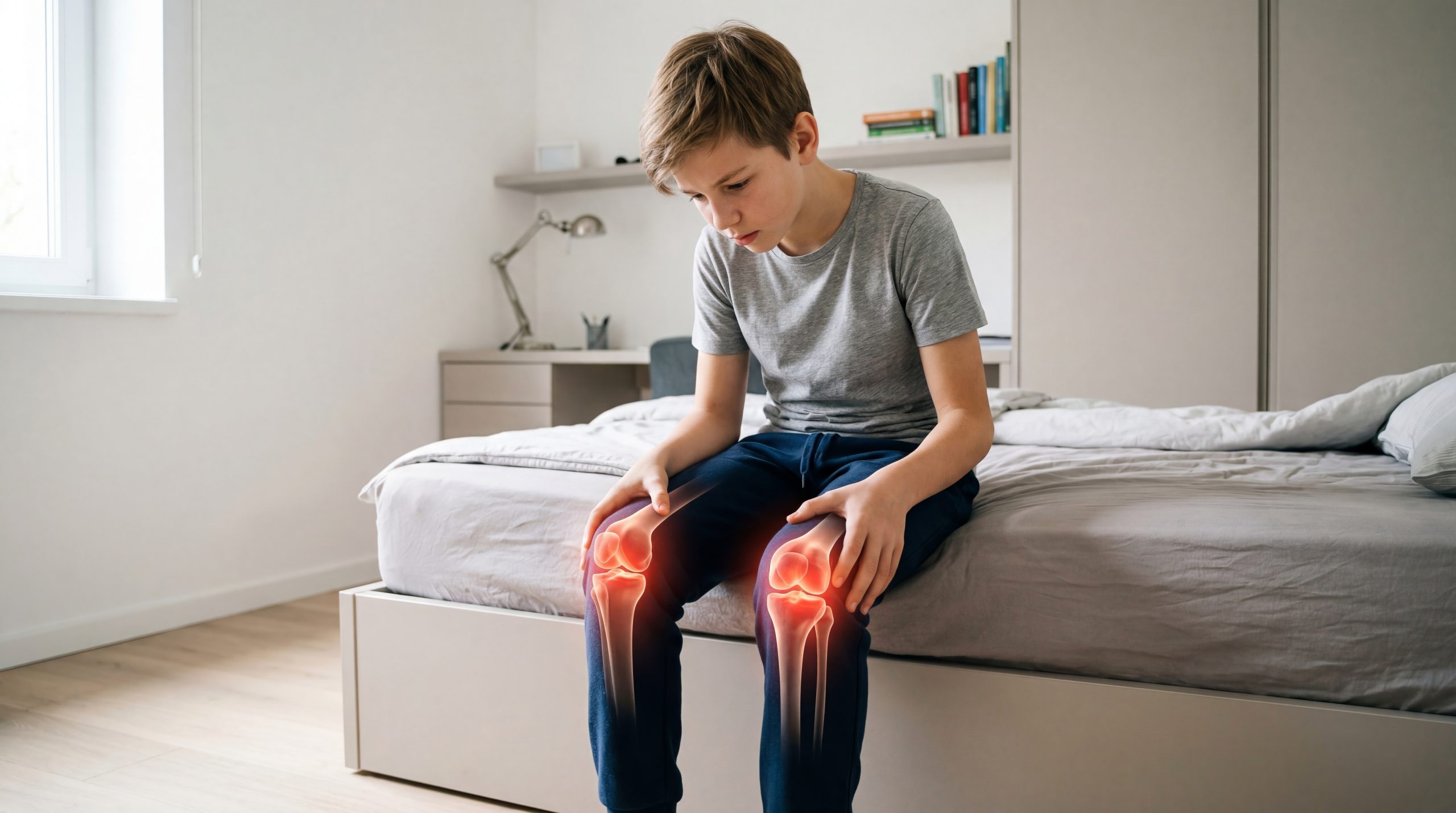
Growing Pains in Kids: What Parents Should Know
Reviewed by: Dr. David Drazic, D.C.
Reviewed for: clinical accuracy, patient safety, scope-of-practice accuracy, and service appropriateness
When a child wakes up at night complaining that both legs ache, “growing pains” is often the first explanation parents hear.
Sometimes that description fits very well. Classic growing pains tend to appear later in the day or at night, affect both legs, disappear by morning, and leave children able to run and play normally between episodes. (Mayo Clinic)
What they are not is proof that your child’s bones are growing too quickly.
Despite more than a century of study, the cause of growing pains remains uncertain. The useful question for parents is therefore not simply “Is my child growing?” but “Does this pain actually follow the typical growing-pain pattern?”
What Are Growing Pains In Children?
Growing pains are recurrent episodes of non-joint leg pain that usually occur during childhood.
Children commonly describe aching or throbbing in the thighs, calves, shins, or behind the knees. Symptoms typically occur in the late afternoon, evening, or overnight and resolve by the next morning. (Mayo Clinic)
The episodes may be unpredictable. A child can have pain one evening and then go days or weeks without another complaint.
Between episodes, a typical physical examination is normal. The child does not usually have persistent tenderness, joint swelling, restricted movement, or a limp. (PubMed Central (PMC))
There is no single laboratory test or X-ray that confirms growing pains. Clinicians identify the condition primarily from its characteristic history while making sure the presentation does not suggest another cause.
Why Are They Called Growing Pains If Growth Does Not Cause Them?
Mostly because the name stuck.
Modern evidence has not demonstrated that growing pains occur during periods of particularly rapid growth or that lengthening bones directly cause the symptoms. (PubMed Central (PMC))
Researchers have studied many possible explanations.
Some evidence has explored differences in pain sensitivity, physical activity, psychological factors, vitamin D levels, genetics, joint mobility, and other potential contributors. No theory has adequately explained every case. (PubMed Central (PMC))
More activity than usual may precede symptoms in some children. That can help explain why a busy day of running, climbing, or jumping is sometimes followed by aching legs at bedtime. (Mayo Clinic)
It still does not establish one universal cause.
How Can You Tell If Leg Pain Fits The Typical Pattern?
The timing and behaviour of the symptoms provide some of the best clues.
Typical growing pains:
- Usually affect both legs
- Occur later in the day or overnight
- Are felt in muscles rather than one specific joint
- Come and go rather than remaining constantly present
- Resolve by morning
- Do not usually cause limping
- Do not prevent normal daytime activity
Those characteristics appear consistently across clinical reviews of growing pains. (PubMed Central (PMC))
No individual feature proves that a child’s pain is harmless, but the complete pattern can help a healthcare professional determine whether growing pains are a reasonable explanation.
When Should Parents Be More Concerned About Leg Pain?
Pain that does not behave like typical growing pains should be assessed rather than repeatedly dismissed.
Mayo Clinic recommends medical evaluation when childhood leg pain is persistent or worsening, affects only one leg, continues during the morning or daytime, interferes with normal activity, involves a joint, or follows an injury. (Mayo Clinic)
Parents should also pay attention to additional symptoms such as:
- Limping
- Swelling or redness
- Significant localized tenderness
- Fever
- Rash
- Weakness
- Unusual fatigue
- Loss of appetite
- Reduced range of motion
These findings can occur for many reasons, and most do not automatically indicate a serious disorder. They do indicate that the complaint no longer matches a straightforward growing-pain pattern.
Is Back Pain A Type Of Growing Pain?
Back pain is not considered a typical feature of growing pains.
Children can develop back pain from muscle strains, sports injuries, overuse, spinal conditions, and other causes. Because the differential diagnosis is different from ordinary nighttime leg aches, pediatric back pain needs to be evaluated separately.
Constant back pain, focal bony tenderness, nighttime pain, or abnormal neurological findings may require additional investigation. (AAFP)
A child who develops back pain alongside weakness, changes in walking, significant trauma, fever, or other systemic or neurological symptoms should receive appropriate medical assessment.
This is an area where telling a child to “wait until they grow out of it” can be the wrong approach.
Do Flat Feet, Posture, Or Spinal Alignment Cause Growing Pains?
Current evidence does not support a simple structural explanation.
Research has explored whether growing pains are related to foot posture, joint mechanics, flexibility, or other biomechanical factors. Reviews have not established a consistent anatomical or mechanical cause, and one evidence review concluded that growing pains were not associated with flat feet. (PubMed Central (PMC))
A child can still have a separate foot, joint, gait, or spinal problem.
For example, persistent pain during activity, one-sided symptoms, restricted movement, or a limp may suggest that a musculoskeletal issue deserves assessment. Those findings should be evaluated directly rather than being retroactively used to explain every case of nighttime leg pain.
Growing pains and musculoskeletal dysfunction are not interchangeable diagnoses.
How Are Typical Growing Pains Managed?
Most classic growing pains are managed with reassurance and simple comfort measures.
Massage and gentle warmth can help during an episode. Mayo Clinic recommends rubbing the affected muscles or applying a warm heating pad for comfort. (Mayo Clinic)
One older evidence review identified limited support for stretching the quadriceps, hamstrings, and calf muscles. However, researchers have repeatedly noted that the overall treatment evidence for growing pains remains relatively limited. (PubMed Central (PMC))
Parents considering pain medication should follow age-appropriate advice from their child’s physician, pharmacist, or another qualified healthcare professional.
Children with an otherwise typical presentation can generally continue normal physical activity.
Where Chiropractic Assessment Fits In
A chiropractor should not automatically treat a child simply because a parent uses the phrase “growing pains.”
Ontario chiropractors are regulated healthcare professionals whose scope includes assessing conditions related to the spine, nervous system, and joints. Chiropractic examinations may include orthopaedic testing, neurological assessment, muscle-function testing, and evaluation of joint function. (College of Chiropractors of Ontario)
That role can be relevant when a child has an actual musculoskeletal complaint, such as persistent joint or spinal symptoms, movement restrictions, or pain that appears to be associated with physical activity or injury.
It is equally important to recognize when the presentation falls outside that scope.
If the history or examination suggests an atypical condition, systemic illness, significant injury, or another problem requiring medical investigation, referral to an appropriate healthcare professional should take priority over treatment.
How Lakeview Chiropractic & Acupuncture Wellness Centre Approaches Musculoskeletal Concerns In Children
Lakeview Chiropractic & Acupuncture Wellness Centre uses an examination-first approach rather than assuming every childhood ache requires an adjustment.
Dr. David Drazic begins by listening to the history of the complaint and examining whether there is a musculoskeletal issue involving the spine or joints that falls within chiropractic scope. The clinic offers both manual and computerized adjusting approaches, and its computerized system can be adapted for children when chiropractic care is clinically appropriate. (Lakeview Chiropractic Wellness Center)
The important phrase is when clinically appropriate.
Typical growing pains may not require chiropractic treatment at all. If a child’s symptoms are persistent, one-sided, present during the day, associated with limping, or otherwise atypical, determining whether medical referral is needed becomes more important than immediately beginning treatment.
That is the standard parents should expect from any healthcare professional assessing their child.
Frequently Asked Questions About Growing Pains In Children
What do growing pains feel like?
Children commonly describe an ache or throbbing discomfort in the thighs, calves, shins, or behind the knees. The pain usually affects both legs and occurs during the evening or overnight. (Mayo Clinic)
How long do growing pains last?
Individual episodes vary and may come and go over an extended period. A child can have pain on some nights and then remain symptom-free for days or weeks. The key feature is that typical episodes resolve by morning rather than producing persistent daytime pain. (Mayo Clinic)
Can growing pains happen in only one leg?
Classic growing pains usually affect both legs. Consistent pain in only one leg is less typical and should be discussed with the child’s healthcare provider, particularly if it is persistent or worsening. (Mayo Clinic)
Should my child stop sports if they have growing pains?
Children with a typical growing-pain pattern generally do not need to stop their usual physical activities. If activity itself produces persistent pain, a limp, joint symptoms, or reduced function, the problem deserves assessment rather than assuming it is growing pains. (Mayo Clinic)
Can growing pains cause swollen knees or ankles?
Swelling is not characteristic of typical growing pains. Joint swelling, redness, restricted movement, or persistent tenderness should be evaluated by an appropriate healthcare professional. (Mayo Clinic)
Should I take my child to a chiropractor for growing pains?
Classic growing pains often require reassurance and simple symptom management rather than chiropractic treatment. A chiropractor can assess musculoskeletal complaints involving the spine and joints, but atypical symptoms or findings suggesting another medical condition should be referred for appropriate medical evaluation. (College of Chiropractors of Ontario)
The Pattern Tells You More Than The Name
Growing pains are real, but the name can sometimes create false reassurance.
Typical episodes follow a fairly recognizable pattern: both legs hurt, symptoms happen later in the day or overnight, there are no concerning physical findings, and the child is back to normal by morning.
Pain that behaves differently deserves a different response.
Watch for persistence, one-sided pain, limping, joint symptoms, daytime discomfort, weakness, fever, back pain, or changes in what your child can normally do.
If your child’s complaint appears musculoskeletal, Lakeview Chiropractic & Acupuncture Wellness Centre can assess the spine and joints and determine whether chiropractic care is appropriate or whether another healthcare provider should be involved.
Medical Disclaimer
This article is for educational purposes only and does not replace evaluation, diagnosis, or treatment by your child’s physician, pediatrician, or another qualified healthcare professional. Growing pains are identified from a characteristic clinical pattern, and other causes of childhood limb or back pain may require additional investigation. Seek appropriate medical care for persistent, worsening, traumatic, systemic, neurological, or otherwise concerning symptoms.
Sources And Clinical References
Mayo Clinic: Growing Pains. Supports the typical age range, location, timing, and bilateral presentation of growing pains as well as symptoms that should prompt medical assessment. (Mayo Clinic)
Sports Health: Growing Pains, When To Be Concerned. Supports growing pains as a generally benign recurrent childhood limb-pain syndrome and outlines features that distinguish a classic presentation from cases requiring additional evaluation. (PubMed Central (PMC))
World Journal Of Orthopedics: Growing Pains, What Do We Know About Etiology? Supports the current uncertainty surrounding the cause of growing pains and the lack of evidence that they are directly caused by rapid physical growth. (PubMed Central (PMC))
American Family Physician: Back Pain In Children And Adolescents. Supports separate evaluation of pediatric back pain and identifies clinical findings that may warrant further medical investigation. (AAFP)
College Of Chiropractors Of Ontario: Who Are Chiropractors? Defines Ontario chiropractic scope of practice and the role of examination, diagnosis, musculoskeletal assessment, and collaboration with other regulated healthcare professionals. (College of Chiropractors of Ontario)